
-
 admin
admin - Posted on
- Categories:Vedic Upchar Product
- 0 comments

Introduction
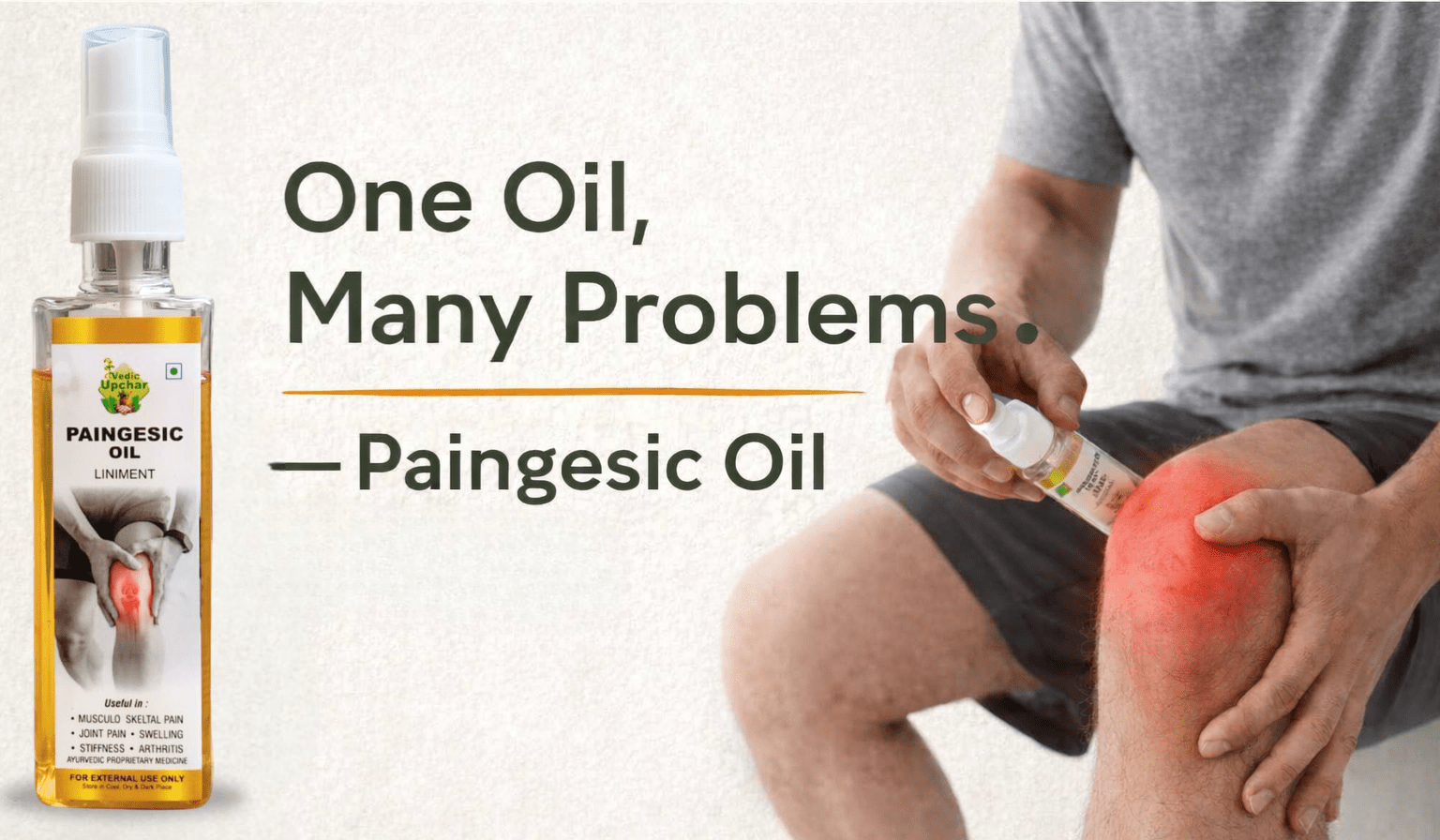
Paingesic oil is a multi-purpose Ayurvedic liniment designed to soothe common musculoskeletal complaints — joint pain, muscle aches, sprains and stiffness. This Yoast-friendly post explains what the oil does, when to use it, how to apply it safely, and when to seek personalised, medicine-aware advice.
The problem
People often juggle several topical products for back pain, knee ache, sprains, shoulder stiffness or general body soreness. That creates inconsistent relief, confusion and exposure to unnecessary chemicals in some OTC gels. A single trusted topical used correctly can simplify care, reduce symptoms faster, and make other treatments (rest, physiotherapy) more effective.
Why choose Paingesic oil for many problems
Paingesic oil is formulated as a warming, anti-inflammatory herbal oil that penetrates locally to ease pain and relax tight tissues. Because it is topical, its action is focussed where you apply it — giving fast local warmth, better circulation and temporary relief from stiffness. It works well as a supportive treatment for:
- Acute sprains and strains (ankle, wrist, shoulder)
- Post-exercise muscle soreness
- Chronic joint stiffness (knees, elbows) as an adjunct to exercise
- Mild nerve-related discomfort (early sciatica, neuralgias) alongside medical care
- Stiffness after long travel or sedentary work
Use it as part of a recovery plan — not as a standalone fix for serious injuries.
Key ingredients & Ayurvedic actions (short)
- Nirgundi (Vitex) — analgesic, reduces local inflammation.
- Bala (Sida cordifolia) — supports muscles and connective tissue.
- Rasna & Turmeric — anti-inflammatory and tissue-supportive.
- Herbal oil base (e.g., sesame) — carries actives into the skin and nourishes the area, balancing Vata.
These botanicals are chosen for topical musculoskeletal support when processed and purified correctly.
How to use Paingesic oil — step-by-step
- Warm the bottle: place the sealed bottle in hot water for 20–40 seconds — don’t overheat.
- Apply amount: 5–10 ml depending on the area.
- Massage: gentle circular strokes for 8–12 minutes, moving toward the heart to encourage circulation.
- Optional: follow with a warm compress for 10–15 minutes to increase penetration.
- Frequency: once daily for maintenance; up to twice daily during flare-ups unless skin irritation appears.

For acute injuries, follow initial RICE (rest, ice, compression, elevation) for the first 24–48 hours; start topical massage after swelling subsides.
Simple home plan pairing Paingesic oil with care
- Acute sprain: RICE → gentle oil massage after swelling reduces → consult if pain worsens or weight-bearing is impossible.
- Chronic stiffness: daily evening massage + warm compress + light mobility exercises.
- Post-exercise soreness: apply 20–30 minutes after cool-down and gentle stretching.
Safety & precautions
- Do not apply on open wounds, infected or heavily bruised skin.
- Patch test first (inside forearm) and stop if there’s rash, burning or blistering.
- Pregnancy & breastfeeding: consult a practitioner before use.
- Blood thinners / skin conditions: check with your doctor before regular topical herbal use.
- If pain is severe, progressive, accompanied by fever, numbness or loss of function — seek urgent medical care; topical oil is supportive, not curative.
Red flags — when a single oil is not enough
Pause topical treatment and get immediate medical/orthopaedic care if you have: inability to bear weight after injury, deformity, sudden neurological signs (numbness, weakness), high fever, or suspected fracture.
Realistic expectations & evidence-based note
Topical herbal liniments can relieve local muscle tension, reduce perceived pain and improve short-term mobility for many mild to moderate complaints. Outcomes depend on the underlying cause: acute soft-tissue pain often responds well; advanced structural conditions (severe osteoarthritis, fractures, infections) need broader medical or surgical management. Use Paingesic oil as part of an integrated plan: movement, physiotherapy, weight management and professional assessment when required.
When to get a personalised consultation
For persistent or recurrent pain, complex injuries, or if you want a coordinated plan (topical + internal herbs + physiotherapy or Panchakarma), book a personalised consultation with:
Vedic Upchar — https://vedicupchar.com/doctor-consultation

Practitioners will assess your condition, advise massage technique and frequency, and coordinate additional therapies safely.
